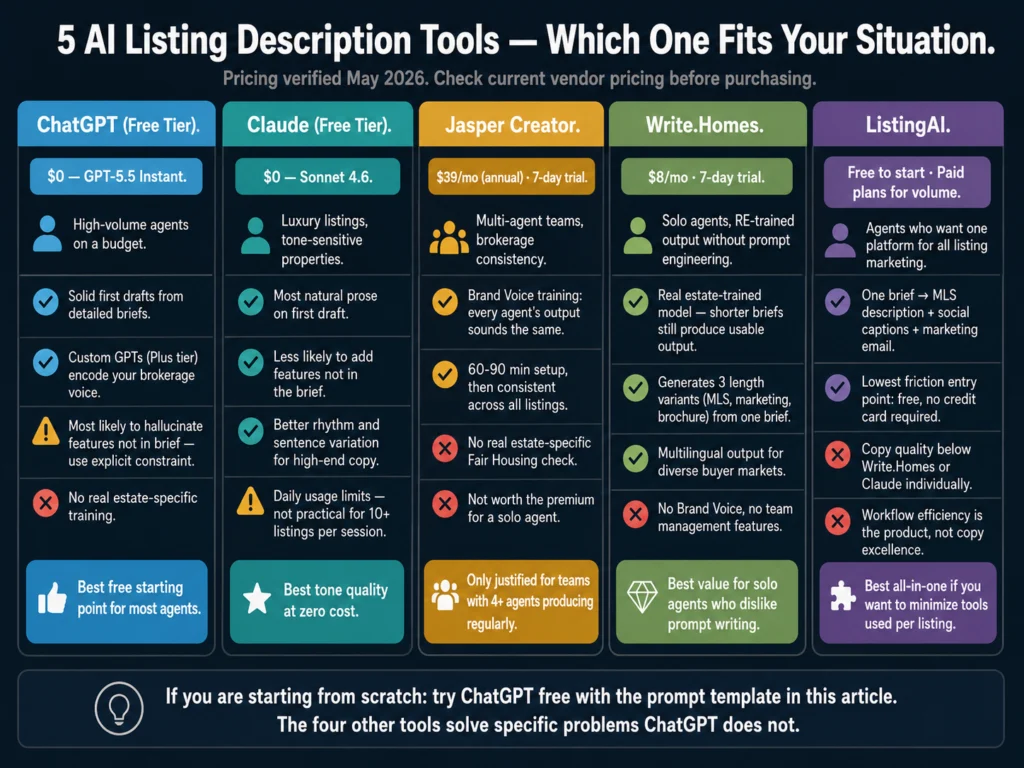
I want to be upfront about a few things before I get into this. I’m not a tech reviewer. I don’t have a clean scientific methodology. What I did was use six different AI tools to write listing descriptions on properties I actually listed over a 90-day stretch, compare the outputs, and track what happened with those listings. It’s not a controlled study, but it’s probably more useful than a review written by someone who isn’t actually using these in a live real estate practice.
Also: I’m not naming the specific tools by name because I don’t want this to be a product ranking that goes stale the minute anyone updates their software. I’ll describe what each type of tool does and whether it was worth the time.
The General AI Tools (ChatGPT-type interfaces)
These are the ones almost everyone has experimented with. The output ranges from surprisingly good to embarrassingly generic depending almost entirely on how specific your prompt is. If you paste in a basic property description and ask for a listing writeup, you’ll get something that reads like it was written by someone who has never been inside a house. If you give it specific sensory details — the way light hits the kitchen in the morning, the sound of the creek behind the yard, the fact that the original 1940s wood floors have been refinished but still have their original character — you get something meaningfully better.
The issue is that “give it specific sensory details” means doing the work that would let a decent human writer produce good copy anyway. The AI is a drafting accelerator, not a replacement for knowing how to observe a property.
My honest assessment: good for getting a first draft quickly. Not a replacement for editing. Still faster than starting from a blank page.
Real Estate-Specific AI Tools
I tried two tools specifically designed for real estate listing copy. One was noticeably better than the general tools at formatting — it knew what a listing description was supposed to look like structurally, it didn’t bury the bedroom count, and it stayed within MLS character limits without being asked. The other one produced copy that was technically competent but had a slightly uncanny quality, like it was written by someone who had read a lot of listing descriptions but never actually bought or sold a home. The sentences were correct but the emotional texture was flat.
For agents who write a lot of listings and want to speed up the mechanical process, the better real estate-specific tools are worth the subscription cost. For agents who write a handful of listings a year and have time to put care into the copy, the value proposition is less clear.
The Thing Nobody Talks About With AI Copy
I’ve started paying attention to listing descriptions from other agents in my market, and I can often tell now which ones went through an AI tool — not because they’re bad, but because they have a particular rhythm and a certain set of go-to phrases that show up repeatedly. “Thoughtfully updated” is one. “An entertainer’s dream” is another. “Bathed in natural light” has reached the point where I wonder if it’s in a default prompt somewhere.
This matters because distinctiveness in listing copy has always been part of its function. A description that reads the same as half the other listings in the MLS is doing less work for your seller than one that actually sounds like it was written by someone who walked through that specific house.
My practical takeaway: use AI to draft, but edit aggressively for the two or three details that make this property actually memorable. The AI output is the floor, not the ceiling.
On the Time Math
Here’s what I actually tracked: using the best AI tool in my test cut my listing description time from roughly 35 minutes (for a property I know well) or 55 minutes (for something I’m less familiar with) to about 15-20 minutes including editing. Over 90 days with the volume I had, that’s a meaningful chunk of time back. The output quality was equivalent or slightly better than what I was doing without it.
That time math will be different for every agent. If you’re fast and your copy is already good, the lift is smaller. If you’ve been using the same basic template for years and your descriptions have gotten formulaic, even imperfect AI output might be an improvement.